What Article 35(A) means
Article 35A allows the state legislature to define the Jammu and Kashmir’s permanent residents. The article had been inserted via the Constitution (Application to J&K) Order, 1954. It was issued by the then President Rajendra Prasad under Article 370 on PM Nehru’s advice.
The state’s Constitution, at the time of its adoption in 1956, defined a permanent resident as someone who was a state subject on May 14, 1954, or who has been a resident for 10 years, and has lawfully acquired immovable property.
What this clause means is that no outsider can now own property in J&K or get a state job.
The article is also known as the Permanent Residents Law. Among other things, it deprives the state’s female residents of property rights if/when they marry an ‘outsider’. The provision also extends to children born of any such women.
HISTORY OF ARTICLE 35A & 370
In October 1947, the then Maharaja of Kashmir, Hari Singh, signed an Instrument of Accession after pak army’s attack, it specified three subjects on which Jammu & Kashmir would transfer its power to the government of India:
1. Foreign affairs
2. Defence
3. Communications
In March 1948, the Maharaja appointed an interim government in the state, with Sheikh Abdullah as prime minister. In July 1949, Sheikh Abdullah and three other colleagues joined the Indian Constituent Assembly and negotiated the special status of J&K, leading to the adoption of Article 370. The controversial provision was drafted by Sheikh Abdullah.
Other princely states which signed the instrument of accession, signed a similar accord but without such provisions.
SPECIAL STATUS WHICH ARTICLE 370 GAVE TO J&K
Article 370 gave some special perks to J&K which no other state enjoys. It also has hindered development of kashmir over years. This special clauses are
1) Separate flag for the state of Jammu & kashmir.
2) Dual citizenship for citizens of kashmir.
3) No non-citizen of kashmir could buy land or property in kashmir.
4) A kashmiri girl marrying any non-kashmiri citizen except someone from pakistan would also be deprived of kashmiri citizenship.
5) Any law ratified by central government could not be implemented unless approved by state legislature if kashmir.
6) Financial emergency and CAG audits couldn’t be invocked in kashmir.
Revoking article 370 now has abbrogated all this provisions. It was extremely important for nation’s and kashmir’s benefit to scrap the article which was initially decided to be for a temporary or a transient period. 70 years of transient period was more than enough to parent the article.
NEED TO REVOKE THE ARTICLE
The article had become a bone of contention for Indian government over the years. It
1) Impedimented any investments into the region from Indian or foreign investors, thus hindering growth, jobs and development of region.
2) unilateral favoritism which residents of J&k got from Indian government.
3) Increase in corruption as no audits would be conducted.
4) Conducive environment for terrorism, which was also fluxed by brainwashed and jobless youth picking arms against state for money.
5) Private universities and education hubs couldn’t be established thus barring youth from quality education and thus free and fair flow of ideas restricted thus not inclining youngsters towards Republican of India.
6) It lead to control of state and its policies to be taken by few families and one’s enjoying there patronage.
7) Another important reason was the problematic kashmir valley only formed 11% of the area of J&K, rest were peaceful regions seeking deep rooted one nation alliance with India. And because of valley other two regions i. e Jammu & Ladakh region also had to suffer
Besides this there were reasons like discontent amongst Indian citizens over kashmir issue and recurring losses of human lives in the valley. All this led to bold and historic decision of scrapping the law and setting the track right.
IMPACT OF THE DECISION
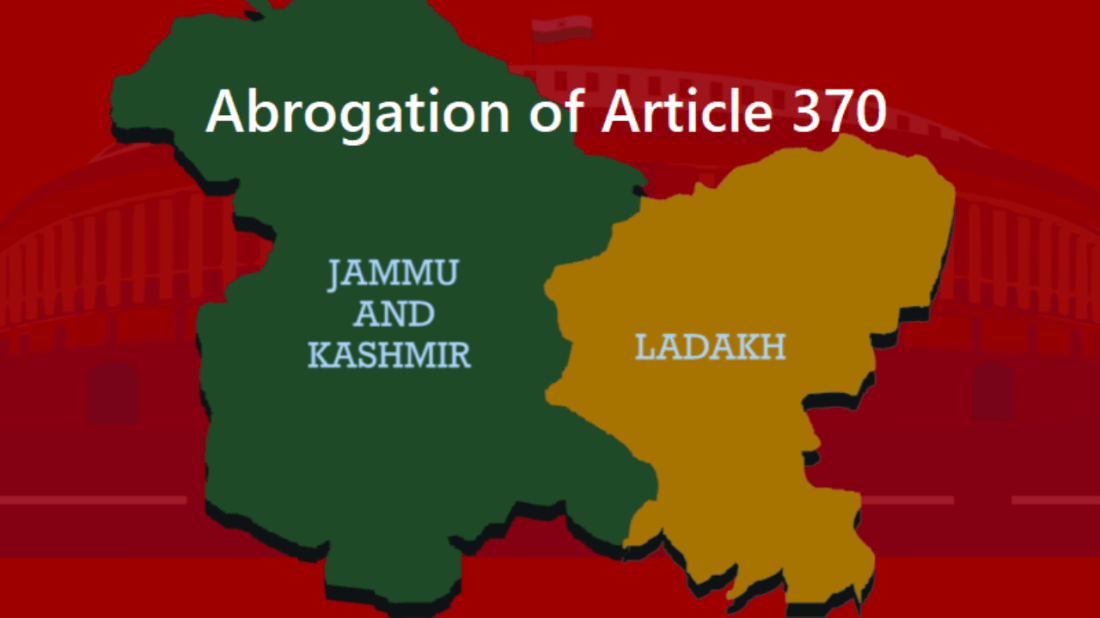
Dividing State of Jammu & Kashmir into union territory of Jammu & Kashmir and union territory of ladakh will come up with economic challenges for Ladakh than for J&K. Also unrest in valley will prevail until citizens see its benefits. Terrorist activities are suspected to increase in the region and also in the country.
Moreover how does international community reacts to this decision will too be interesting to see. This move has strengthened India’s claim over kashmir and wrecked pakistani hopes of settling the kashmir issue. The decision also comes soon after Donald Trumps claims of PM MODI requesting his US counterpart to act as mediator in the issue. It has also been seen by many analysts as a tight slap to Mr. Trump.
The decision without will prove to good for India in long run and bring kashmiri youth closer to India.
Thank you!!!


 PK'S BLOG